
This is a tale of two first OSCARs (Orbiting Satellite Carrying Amateur Radio), American OSCAR I and Canada-OSCAR 128.
American OSCAR I
In December, 1961, when I was at Case Western Reserve University, a group of amateur radio operators combined their effort to listen to a satellite. One student’s task was the orbital calculations. One student’s task was the azimuth control. One student’s task was the elevation control. One student’s task was the frequency control. I had the good fortune to hear the distinctive HI HI in Morse code of the American OSCAR I.
73, John DeDourek, VE9TFB, ex K8TFB
Canada-OSCAR 128
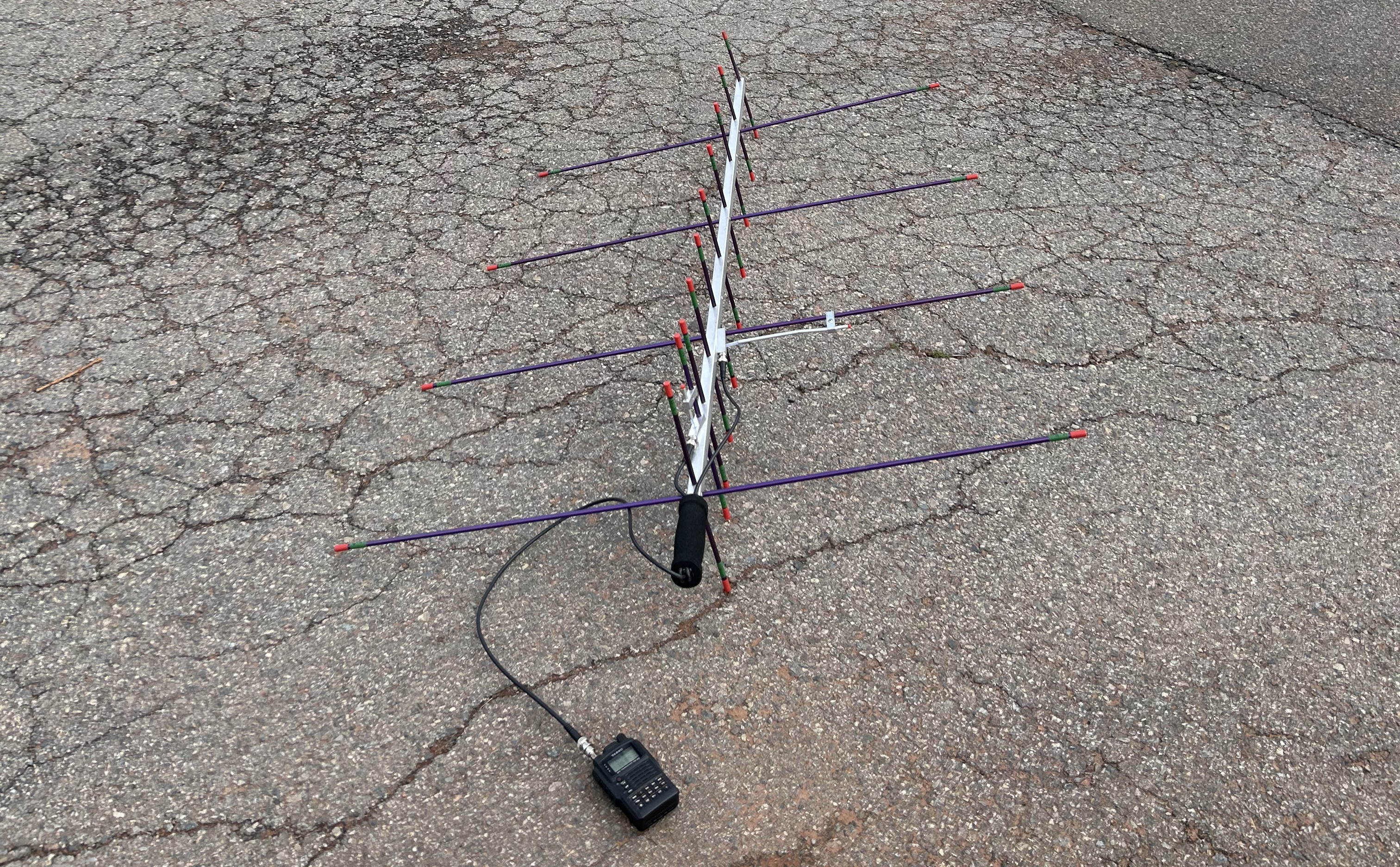
In August, 2026, when I was in Prince Edward Island, I used my equipment to listen to a satellite. My cell phone could track azimuth and elevation. My portable radio was a Yaesu VX-8GR set to receive amplitude modulation, and the antenna was an Arrow II 146/440-14, with a 4-element VHF Yagi. I had the good fortune to hear CQ DE VA7UVS in Morse code, the call sign of Canada-OSCAR 128, CO-128, MARMOTSat, transmitting on 145.875 MHz. An image of the equipment is shown.
An audio clip is available, an mp3 of duration 10 s, that I made of the AM mode output where one can hear a higher level of static, instead of a tone, when MARMOTSat is transmitting. The buzzing sound at the start, on top of the CQ is because I was standing under a power line. Since I was receiving and not transmitting, I found when I put my finger on the aluminum main boom of the antenna, the distortion disappeared and then DE VA7UVS was easier to hear. This reminded me of the intentional feedback the Beatles put at the start of I Feel Fine.
73, Brent Petersen, VY2/VE9EX, W1IY